


- University
- Academic
- Schools/Vocational Schools
- Vocational School of Justice
- Vocational School
- Vocational School
- Department of Banking and Insurance (Turkish)
- Department of Computer Programming (Turkish)
- Department of Foreign Trade (Turkish)
- Department of Graphic Design (Turkish)
- Department of Interior Design (Turkish)
- Department of Construction Technology (Turkish)
- Department of Occupational Health and Safety (Turkish)
- Department of Media and Communication (Turkish)
- Department of Architectural Restoration (Turkish)
- Department of Radio and Tv Programming (Turkish)
- Department of Civil Aviation Cabin Services (Turkish)
- Department of Civil Aviation Transportation Management (Turkish)
- Department of Tourism and Hotel Management (Turkish)
- Department of Applied English Translation
- Vocational School Of Health Services
- Vocational School Of Health Services
- Department of Child Development (Turkish)
- Department of Physiotherapy (Turkish)
- Department of Paramedic (Turkish)
- Department of Opticianry (Turkish)
- Department of Medical Documentation and Secreteriat (Turkish)
- Department of Medical Imaging Techniques (Turkish)
- Department of Medical Laboratory Techniques (Turkish)
- Department of Elderly Care (Turkish)
- School of Applied Management Sciences
- School of Foreign Languages
- Faculties
- Faculty of Arts and Sciences
- Faculty of Fine Arts and Design
- Faculty of Law
- Faculty of Communication
- Faculty of Business
- Faculty of Engineering
- Faculty of Engineering
- Department of Computer Engineering
- Department of Biomedical Engineering
- Department of Electrical and Electronics Engineering
- Department of Industrial Engineering
- Department of Food Engineering
- Department of Genetics and Bioengineering
- Department of Aerospace Engineering
- Department of Civil Engineering
- Department of Mechanical Engineering
- Department of Mechatronics Engineering
- Department of Software Engineering
- Faculty of Health Sciences
- Medicine
- Graduate School
- Common Courses
- Schools/Vocational Schools
- Research
- Research Centers
- Library
- Smart Campus
- Technology Transfer Office
- İzmir Sciencepark
- Continuous Education Center (EKOSEM)
- Children's University
- Ethics Committee
- Teaching and Learning Center (EKOEĞİTİM)
- Psychology Application and Research Center
- Researcher Training Coordinatorship
- Research Collaborations And Innovation Coordinatorship
- Campus
- INTERNATIONAL
- Contact
- 25TH YEAR
Department of Food Engineering
MATH 208 | Course Introduction and Application Information
| Course Name |
Introduction to Differential Equations II
|
|
Code
|
Semester
|
Theory
(hour/week) |
Application/Lab
(hour/week) |
Local Credits
|
ECTS
|
|
MATH 208
|
SPRING
|
2
|
2
|
3
|
5
|
| Prerequisites | MATH 207 To get a grade of at least FD | |||||
| Course Language | English | |||||
| Course Type | Required (Core Course) | |||||
| Course Level | First Cycle | |||||
| Mode of Delivery | face to face | |||||
| Teaching Methods and Techniques of the Course | Problem Solving Case Study Q&A Simulation | |||||
| National Occupational Classification Code | - | |||||
| Course Coordinator |
|
|||||
| Course Lecturer(s) |
|
|||||
| Assistant(s) | - | |||||
| Course Objectives | This course includes classification, applications and solution methods of partial differential equations. Fourier series for periodic functions, solution of heat and wave equation by separation method, solution methods of Laplace equation in rectangular and polar coordinates are aimed. | |||||||||||||||||||||||||||||||||||||||||||||||||||||
| Learning Outcomes |
The students who succeeded in this course;
|
|||||||||||||||||||||||||||||||||||||||||||||||||||||
| Course Description | In this course basic concepts and classification of partial differential equations will be discussed. The heat, wave and Laplace equation will be given and the solution methods will be taught. | |||||||||||||||||||||||||||||||||||||||||||||||||||||
| Related Sustainable Development Goals |
-
|
|||||||||||||||||||||||||||||||||||||||||||||||||||||
|
|
Core Courses |
X
|
| Major Area Courses |
|
|
| Supportive Courses |
|
|
| Media and Managment Skills Courses |
|
|
| Transferable Skill Courses |
|
WEEKLY SUBJECTS AND RELATED PREPARATION STUDIES
| Week | Subjects | Required Materials | Learning Outcome |
| 1 | Mathematical background for the study of partial differential equations | Erwin Kreyszig, “Advanced Engineering Mathematics”,10Th Edition, (John Wiley and Sons), Sections 9.5, 9.7, 9.8 | - |
| 2 | Description of partial differential equations. Classification and model definitions. First order partial differential equations | Yehuda Pinchover and Jacob Rubistein, “An Introduction to Partial Differential Equations”, (Cambridge University Press, 2005), Sections 1.1. to 1.7 | - |
| 3 | Modelling first order partial differential equations. Solving by the method of characteristics | Yehuda Pinchover and Jacob Rubistein, “An Introduction to Partial Differential Equations”, (Cambridge University Press, 2005), Sections 2.1. to 2.4 | - |
| 4 | Modelling continuity equation, wave equation and traffics flow and applications | Yehuda Pinchover and Jacob Rubistein, “An Introduction to Partial Differential Equations”, (Cambridge University Press, 2005), Sections 2.1. to 2.4 | - |
| 5 | Partial Laplace transform. Solving first order partial differential equations by partial Laplace transform. | “http://www.math.ttu.edu/~gilliam /ttu/s10/m3351_s10/c15_laplace_trans_pdes.pdf” Chapter 15 | - |
| 6 | Heat Equation. Solution by separation of variables. Existence and Uniqueness of Solutions. | Kent Nagle, Edward B. Saff and Arthur David Snider, “Fundamentals of Differential Equations and Boundary Value Problems” 6th Edition, (Pearson, 2011), Section 10.5. | - |
| 7 | Heat and diffusion equations examples and interpretation of the solution results | Kent Nagle, Edward B. Saff and Arthur David Snider, “Fundamentals of Differential Equations and Boundary Value Problems” 6th Edition, (Pearson, 2011), Section 10.5-10.7 | - |
| 8 | The wave equation. Solution by seperation of variables. Existence and Uniqueness of Solutions. | Kent Nagle, Edward B. Saff and Arthur David Snider, “Fundamentals of Differential Equations and Boundary Value Problems” 6th Edition, (Pearson, 2011), Section 10.6. | - |
| 9 | Midterm Exam | - | |
| 10 | The Laplace's equation in rectangular coordinates. Solution by separation of variables. Existence and Uniqueness of Solutions. | Kent Nagle, Edward B. Saff and Arthur David Snider, “Fundamentals of Differential Equations and Boundary Value Problems” 6th Edition, (Pearson, 2011), Section 10.7. | - |
| 11 | Laplace's equation in polar coordinates and its solution by the method of separation of variables. | Kent Nagle, Edward B. Saff and Arthur David Snider, “Fundamentals of Differential Equations and Boundary Value Problems” 6th Edition, (Pearson, 2011), Section 10.7. | - |
| 12 | Solving second order partial differential equations by partial Laplace transform. | “http://www.math.ttu.edu/~gilliam/ttu/s10/m3351_s10/c15_laplace_trans_pdes.pdf” Chapter 15 | - |
| 13 | Numerical solutions of heat equation | David R. Kincaid and E. Ward Cheney, “Numerical Analysis”, (Brooks/Cole, 1991), Sections: 9.1,9.2 | - |
| 14 | Numerical solutions of wave equation | David R. Kincaid and E. Ward Cheney, “Numerical Analysis”, (Brooks/Cole, 1991), Sections: 9.1,9.2 | - |
| 15 | Semester review | - | |
| 16 | Final exam | - |
| Course Notes/Textbooks |
Kent Nagle Edward B. Saff and Arthur David Snider “Fundamentals of Differential Equations and Boundary Value Problems” 6th Edition (Pearson 2011) ISBN-13: 978-0321747747. |
| Suggested Readings/Materials |
Readings/Materials
Yehuda Pinchover and Jacob Rubistein “An Introduction to Partial Differential Equations” (Cambridge University Press 2005) ISBN-13:978-0-521-84886-2 Erwin Kreyszig “Advanced Engineering Mathematics” 10Th Edition (John Wiley and Sons) ISBN: 978-0-470-45836-5 David R. Kincaid and E. Ward Cheney “Numerical Analysis” (Brooks/Cole 1991) ISBN-10: 0-534-13014-3 |
EVALUATION SYSTEM
| Semester Activities | Number | Weighting | LO1 | LO2 | LO3 | LO4 | LO5 |
| Homework / Assignments | 1 | 20 | X | X | X | X | X |
| Midterm | 1 | 30 | X | X | X | X | X |
| Final Exam | 1 | 50 | X | X | X | X | X |
| Total | 3 | 100 |
ECTS / WORKLOAD TABLE
| Semester Activities | Number | Duration (Hours) | Workload |
|---|---|---|---|
| Participation | - | - | - |
| Theoretical Course Hours | 16 | 4 | 64 |
| Laboratory / Application Hours | - | - | - |
| Study Hours Out of Class | 14 | 3 | 42 |
| Field Work | - | - | - |
| Quizzes / Studio Critiques | - | - | - |
| Portfolio | - | - | - |
| Homework / Assignments | 1 | 10 | 10 |
| Presentation / Jury | - | - | - |
| Project | - | - | - |
| Seminar / Workshop | - | - | - |
| Oral Exams | - | - | - |
| Midterms | 1 | 14 | 14 |
| Final Exam | 1 | 20 | 20 |
| Total | 150 |
COURSE LEARNING OUTCOMES AND PROGRAM QUALIFICATIONS RELATIONSHIP
| # | PC Sub | Program Competencies/Outcomes | * Contribution Level | ||||
| 1 | 2 | 3 | 4 | 5 | |||
| 1 |
Engineering Knowledge: Knowledge of mathematics, science, basic engineering, computation, and related engineering discipline-specific topics; the ability to apply this knowledge to solve complex engineering problems. |
||||||
| 1 |
Mathematics |
LO1 LO2 LO3 LO4 LO5 | |||||
| 2 |
Science |
||||||
*1 Lowest, 2 Low, 3 Average, 4 High, 5 Highest
NEWSALL NEWS



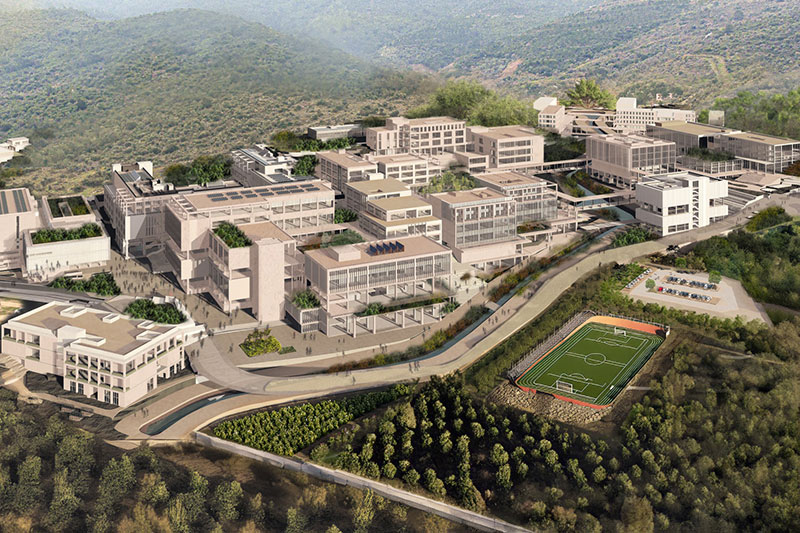
IZMIR UNIVERSITY OF ECONOMICS GÜZELBAHÇE CAMPUS
DetailsGLOBAL CAREER
As Izmir University of Economics transforms into a world-class university, it also raises successful young people with global competence.
More..CONTRIBUTION TO SCIENCE
Izmir University of Economics produces qualified knowledge and competent technologies.
More..VALUING PEOPLE
Izmir University of Economics sees producing social benefit as its reason for existence.
More..
You are one step ahead with your graduate education at Izmir University of Economics.